"Can I store sulfuric acid in a poly tank?" gets asked a lot, and it has no single answer. Two numbers decide it: how strong the acid is, and how warm the tank runs.
What the resistance chart shows
Our chemical resistance chart rates polyethylene (PE) and cross-linked polyethylene (XLPE) at two temperatures, 70°F and 140°F. A rating of A means excellent, B good, C not suggested. Here is how sulfuric acid reads down the chart:
- Up to 50%: PE and XLPE both rated A at 70°F and at 140°F.
- 70%: A at 70°F, dropping to B at 140°F for both.
- 80%: PE is A at 70°F but C at 140°F. XLPE holds at B when hot.
- 96%: PE and XLPE both B at 70°F, C at 140°F.
- 98% (concentrated): PE B at 70°F, XLPE C. Both C at 140°F.
- Fuming acid (oleum): C across the board for both.
Read it that way and the pattern is plain. Dilute acid is an easy job for poly. Strong acid that gets hot is not.
Texas heat counts
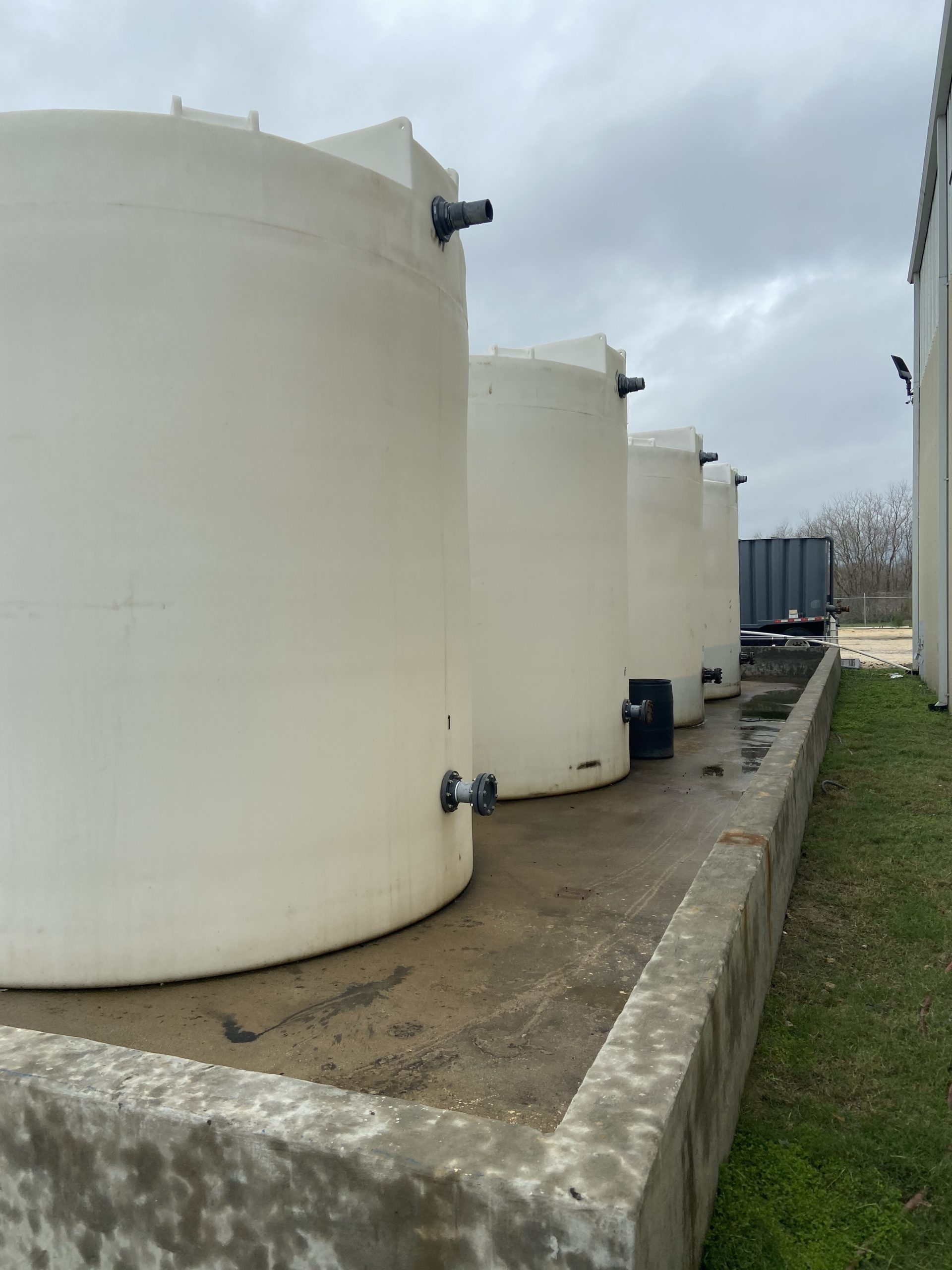
140°F sounds like a process temperature, but a dark tank in direct summer sun can get its wall and its top few feet of liquid well above the air temperature. A tank that is comfortably inside its rating in March can sit at the edge of it in August. If strong acid is going outdoors, shade and tank color are part of the specification, not an afterthought.
The chart is a general guide. The final call on a given concentration, temperature and fitting package belongs to the resin data for that tank, so give us the actual numbers, not "sulfuric."
The acid pulls water out of the air
Concentrated sulfuric acid is hygroscopic: it absorbs moisture from the air. Every time the level drops, the tank breathes in outside air through the vent, and on the Gulf Coast that air is wet. The acid takes up the water and the surface layer becomes weaker acid.
That matters two ways. The strength you bought is not the strength you have, and a diluted layer can attack materials that were fine with the concentrated product. Bulk acid tanks commonly use a desiccant dryer on the vent so the air coming in is dry. Size the vent for the fill and draw rate first, then add the dryer.
Dilution makes heat
Sulfuric acid and water give off a lot of heat when they mix. That is why the rule is acid into water, never water into acid. For a storage tank it means two things: never use a tank that previously held strong acid as a mixing vessel without a plan for the heat, and never wash a strong-acid tank out with a small amount of water. Drain it, then flush with a large volume.
It is heavy
Concentrated sulfuric acid runs about 1.84 specific gravity, close to twice the weight of water. A standard 1.5 rated tank is not built for that. The tank wall, the stand and the pad all have to be sized for the real number. Our specific gravity article covers what the rating means and what happens when it is too low.
Steel works the other way around
Carbon steel is the surprise in this story. Concentrated acid, 93% and up, is routinely stored in carbon steel because the steel forms a protective film. Dilute acid attacks carbon steel quickly. So steel is strongest where poly is weakest, and poly is strongest where steel fails. The industry reference for strong acid in metal is AMPP's recommended practice for 90 to 100% sulfuric acid at ambient temperature.
The resistance chart rates 316 stainless C for most sulfuric strengths, so "just use stainless" is not the fallback it sounds like.
What to bring to a quote
- The acid concentration, as a percentage, and whether it changes over time.
- The highest temperature the tank will see, indoors or out.
- Fill and draw rates, so the vent can be sized.
- Whether the tank needs secondary containment, and what your site or permit requires.
With those four answers we can tell you whether polyethylene, XLPE, fiberglass or steel is the right tank, and say why.
Have a project on the board?
Tell us the chemistry, capacity, and ship-to ZIP — we'll have a real quote back the same business day.